What is a digipak?
A digipak is a patened style of CD, DVD or BD packaging. They normally are made up of six pannels but can be made of more. They tend to use paperboard or card because it is cheap and easy to mould to the shape you desire.
Digipak Analysis
Above is the digipak for band Evenescence. As you can see above the front pannel hilights the lead singer and the colours of contrasting light and dark reflect the music. This is to make a customer feel more aware of what they are buying.
The back pannel is very simplistic only giving a list of the songs on the CD and then inside are the CD and more pictures of the band. This is a very simple example of a digipak but it is also very effective with the use of colour and editing on the pictures.
Hype Williams is one of the best know music video directors ever and his style of a simplistic setting and mise en scene draws you to the artist. He has used this style in two of his most recent videos in the form of 'Gold Digger' by Kanye West (2009) and 'Video Phone' by Beyonce (2009). In other videos wuch as 'So Sick' by Neyo(2009) Williams has used more mise-en-scene then he normally does with props, but it still doesn't distract from the artist. This is what I am inspired by for a music video.
The styles of this video and the 'Gold Digger' video can still be compared as a lot of the same editing skills are used, but 'So Sick' has a more natural feel to it which happens to be what my group is going for. The video contains flash backs to a past relationship and also a lot of shots in outdoor scenery. We were palying around with using these ideas in our video, but decided against the first one soon after.
From 2009 onwards Williams would say his style was a center focus on the artists body from the torso up and a coloured background and soft coloured lights in the background. This tecnique is not used in the particular video I am looking at but is something we should take into consideration when creating out video.
The concentration of media ownership, also known as media consolidation or media convergence, refers to a process where pregressively fewer individuals or organisations have control of the mass media market. Through this there are 'The Big Six' in the media world, these are General Electric, Walt Disney, News Corp, Time Warner, VIACOM and CBS each revenue between $157 billion and $13 billion a year. VIACOM (revenuing $13.5billion a year) owns MTV and music game developers Harmonix, this gives them quite a large say in the music industry.
The music industry is one of the most competitive markets. It is a bigger industry and harder to break into than others, it is built up by compositions, performances and recordings. The music industry is ran by many different people such as artists, producers, managers, songwriters, studio engineers ect.
The music market has expanded over the last couple of years with the increasing use of downloads through iTunes, this gave people a different and easier way to access music. The music industry is also under threat from piracy as most people download their music illegally.
The main music producers in the music industry are now independent labels, however the company Universal Music Group have the biggest individual share. Sony BMG, EMI and Warner Music Group are the other 3 main contributors to the music industry. This means although for our artist these would be ideal, it wouldn't be realistic for them to get signed by them immediately. A more suitable choice for our artist would possibly a label like Cherry Tree Records. Current artists include Ellie Goulding, Far East Movement and LMFAO. The label also used to manage Lady Gaga and Noah and The Whale before they signed with one of the main labels. Also the company is based in the USA so would be more feasible for our artist than a british label.
Pop music is commercially recorded music that is often aimed at a youth market. The songs tend to be short and simple and produce new variations on existing themes. Songs tend to be a verse and repeated chorus. Songs tend to be 2 1/2 minutes long to 5 1/2 minutes long, although there are exceptions.
Indie
Indie music, originally called independent music is a style of music where the artist is independent from major record labels, a 'Do-it yourself' approach to the industry.Indie artist have only recently started to feel commercial success with the turn of the internet. It allowed indie artists to get their music out there.
Rock
Rock music was a popular type of music in the 1960's onwards, but dates back to the 40's and 50's with 'Rock and Roll' music. Rock is particularly popular in the UK and USA. Rock music drew influence from several other genres such as jazz and classical.
Hip-Hop Hip-Hop is a popular urban youth culture, closely associated with rap music and with the style and fashions of African-American inner-city residents. Hip-Hop is described as a form of musical expression and tends to see artists talking about their 'rough upbringing' or 'extravagant life now'.
For the analysis of a traditional pop video I will be looking at the artist Ke$ha and her video for the song 'Take It Off'.
At the start of the video while the backing beat plays we open to a long shot of the setting this establishes where we are. The mise en scene in the scene shows that they are in a deserted setting which is a recurring theme in 'party-style' pop videos. Also the lighting through the sun in the shot provides interesting shadows and sets up that the video is in the setting of late afternoon. From this as the beat kicks in we go to close ups of certain sections of the setting. One of these that looks particularly good is the close up of the motel sign. This is something that is done with this shot as it shows the grungy party girl feel the record company want to give the artist. The motel sign is old, dirty and rusty, this is what provides the grungy feel. This helps establish who the record company are making this artist into. This is another common theme of a pop video. Record companies like to establish a pop artist as a certain stereotype to an audience so that they can find their target audience.
The video continues to have a mid shot of our artist getting off of a motorcycle just before the singing kicks in. In the background of this shot there the side of a curb that we can see was once painted white. The white paint on the side of the curb is coming off and fading. The artist is wearing all black with silver jewelry and an orange helmet. She is on a black motorcycle and is seen getting off. Then there is a jump cut to a close up of her walking just feet away from wear seconds before, this is done a lot in pop videos. For the first few seconds the artist is just walking and singing to camera as the camera tracks her. The camera switches between close ups and two shots of other people as well as our artist walking and jumping over cars.
When the music speeds up the women in the video start to dance and the men start to run up the flights of stairs in the motel. As you can see at the side the artist is always central and in focus, keeping the people behind her blurry keeps the focus on the artist at all times. The artist is singing into camera and doing actions towards the camera engaging the audience the whole time. The people round her continue running and dancing round to create a lively 'party' atmosphere. This is most probably to help record sales as it would make the song more of a 'feel good' song.
There are various flashes to the artist in a different environment through-out. She has mountains behind her and is in sand. This is to draw attention to the artist as in those shots there is nothing to detract from her. The video continues to an explosion of colour with different colour powder flying everywhere. This is possibly to add to the feel of a 'feel good' song.
For my second analysis I am looking at the video for 'Foundations' by Kate Nash. This is a good video to look at for us as it is in a bedroom and this is an idea we have been playing around with from the start of our research and planning.
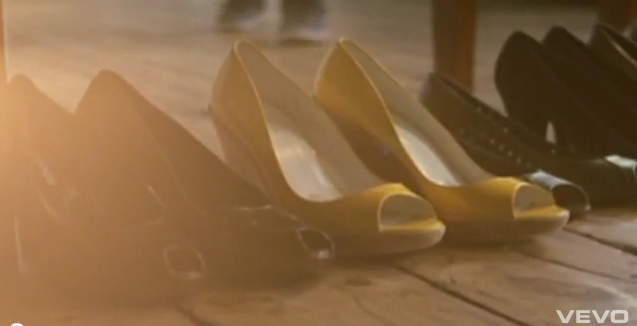
At the start of this video and through-out their are shots of objects that go to the beat. The opening has three shots of different objects that go to the three opening beats. The objects are in pairs of two such as, two toothbrushes, two watches on a table and two pairs of shoes, this goes with the theme of the video and how it's about a relationship. The last shot of the two sets of shoes is broken up by a bowling ball being thrown at it, this shows the main theme of the video in it being a 'break-up' song.
Also these shoes are worn later in the video by the artist and the one stand out colour suggest one person is more important than the other. The other images are of two toothbrushes together, and a side table with two watches, a tape and a telephone. Yet again one watch stands out as the other is just out of frame with just bits of it showing. This suggests independence and a solitary state for the artist through-out the song. After this part of the song our artist is seen playing a board game with the male in the video with her. This is a very childish look and relates to the simple style of the artist. The artist uses simple lyrics and her soft voice to present very adult ideas in a childish way. This is possibly to give less shock value to the lyrics used. Also during the game of chess the two are playing there are cuts to the artist alone singing to the camera
This allows the audience to feel that the artist is addressing them directly. This is used in lots of music videos as the aim of a video is to get more people to buy the song and get the music out to a broader audience. Singing to camera allows the viewer to feel as though the artist is addressing their problems and they are directly involved. A few times the artist looks down towards the floor or away from camera, this is to avoid the video being too intense because the song, although a 'break-up' song is still rather light hearted. The light colours used for costume through the video also relate to this light hearted look and feel.
Also during the video certain lyrics such as 'you say I must eat so many lemons' and 'why don't you just have another beer then' provoke actions in the video. In 'you say I must eat so many lemons' the artist is eating lemons (right) and during 'why don't you just have another beer then' the artist is by an open fridge of beer. Also in the video the artist turns very romantic images such as a couple cuddled up on the sofa laying on each other into a very bitter and nasty image. The use of bright colour, heavy mise en scene, different sets and different types of shot make the video a good video for the individual artist. Shots include high angle, low angle, close up, extreme close up and two shot. Most of these shots are close ups.
1920's
Oscar Fischinger, a German man created short films for music tracks and visual material in Germany e.g. 'Komposidion in Blau' (1935)
1930's
Oscar Fischinger worked on the disney film 'Fantasia' the film was hugely backed by music with no dialogue. This was this first real sign of music videos using animation.
1940's
The Panarom was invented. It allowed music and film to be played together, but the user couldn't select the film. The Panarom died out after the war.
1950's
Television coverage of pop music tried to attract a new teenage audience from 'American Bandstand' through 'Ready Set Go' and 'Top of the Pops'
1960's
The Scopitone was invented the machine lets the user play, skip and rewind 36 short colour films. Around 1000 machines were installed before dying out in the mid 60's because of television.
1970's
In the 70's 'serious rock' gained places on television such as 'The Old Grey Whistle Test'. Promo clips became massively popular with bands these gained airplay on television.
1980's
MTV began broadcasting on the Warner satellite. Viacom bought MTV, a major media conglomerate. Later launching MTV in Europe lead to a swift acceleration in views and subscribers. By the end of the 80's it was vital to have a music video for a successful record.
1990's
Hype Williams lead the way for black artists in the music industry producing videos for people such as TLC, Missy Elliot and R.Kelly. By the late 90's he was commanding budgets of $2million. His work generated high record sales in return.